Types of Fire Extinguishers and Their Uses
A practical map of the six fire extinguisher classes in use across Indian businesses today — what each one fights, what it doesn't, and how to choose between them.
Last reviewed 7 May 2026 · 8 min read
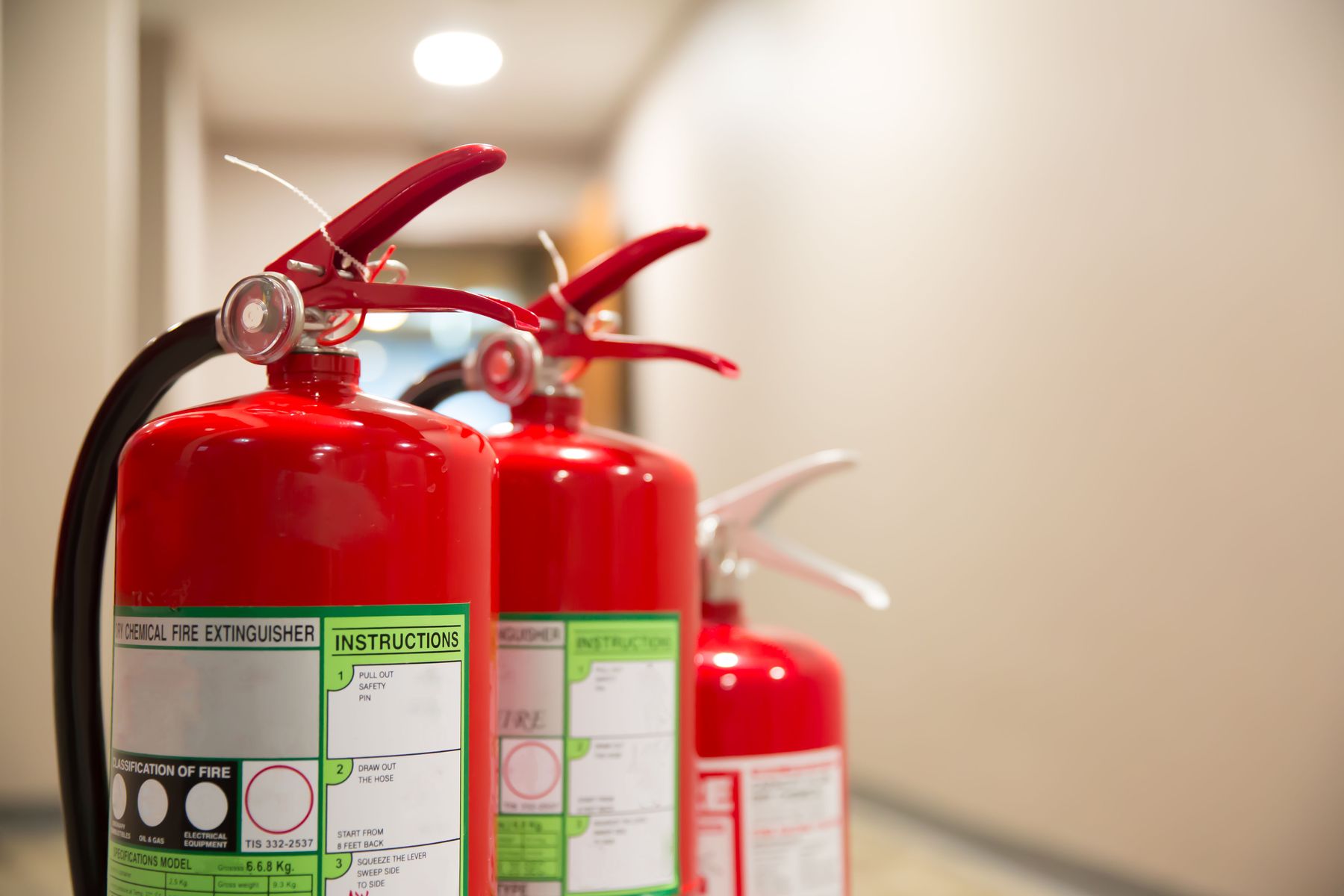
Pick the wrong extinguisher and you can make a fire worse. Pick the right one — and a small incident stays small. This guide walks through every fire extinguisher type sold in India, the fire class it's rated for, the BIS / IS standard it must meet, and exactly where it belongs in your building. The numbers here are pulled directly from the National Building Code of India (NBC 2016, Part 4) and the relevant Bureau of Indian Standards specifications, not approximations.
The fire-class system: A, B, C, D, K and electrical
Every fire and every extinguisher is classified by what's burning. India follows IS 15683:2018, which mirrors the EN 2 / ISO 3941 system used internationally:
- Class A — ordinary combustibles: paper, wood, cardboard, cloth, plastics, rubber. Combustion is sustained by glowing embers; the agent must cool below auto-ignition temperature.
- Class B — flammable and combustible liquids: petrol, diesel, kerosene, paint thinner, lubricating oils. Vapour above the liquid surface is the actual fuel; the agent must blanket or starve the surface.
- Class C — flammable gases: LPG, CNG, acetylene, hydrogen. The first response is to shut off the gas supply; an extinguisher controls secondary fires only.
- Class D — combustible metals: magnesium, sodium, lithium, titanium, aluminium dust. Most agents react violently with these; only specific metal-class powders (Class D agents like graphite or salt-based) are safe.
- Class K (Class F in EN) — cooking oils and fats at high temperature in commercial kitchens. The agent must saponify the oil into a stable foam layer.
- Electrical fires — not a separate class but a hazard scenario; the agent must be non-conductive at the rated voltage. CO₂ and Clean Agents are rated; water and foam are not.
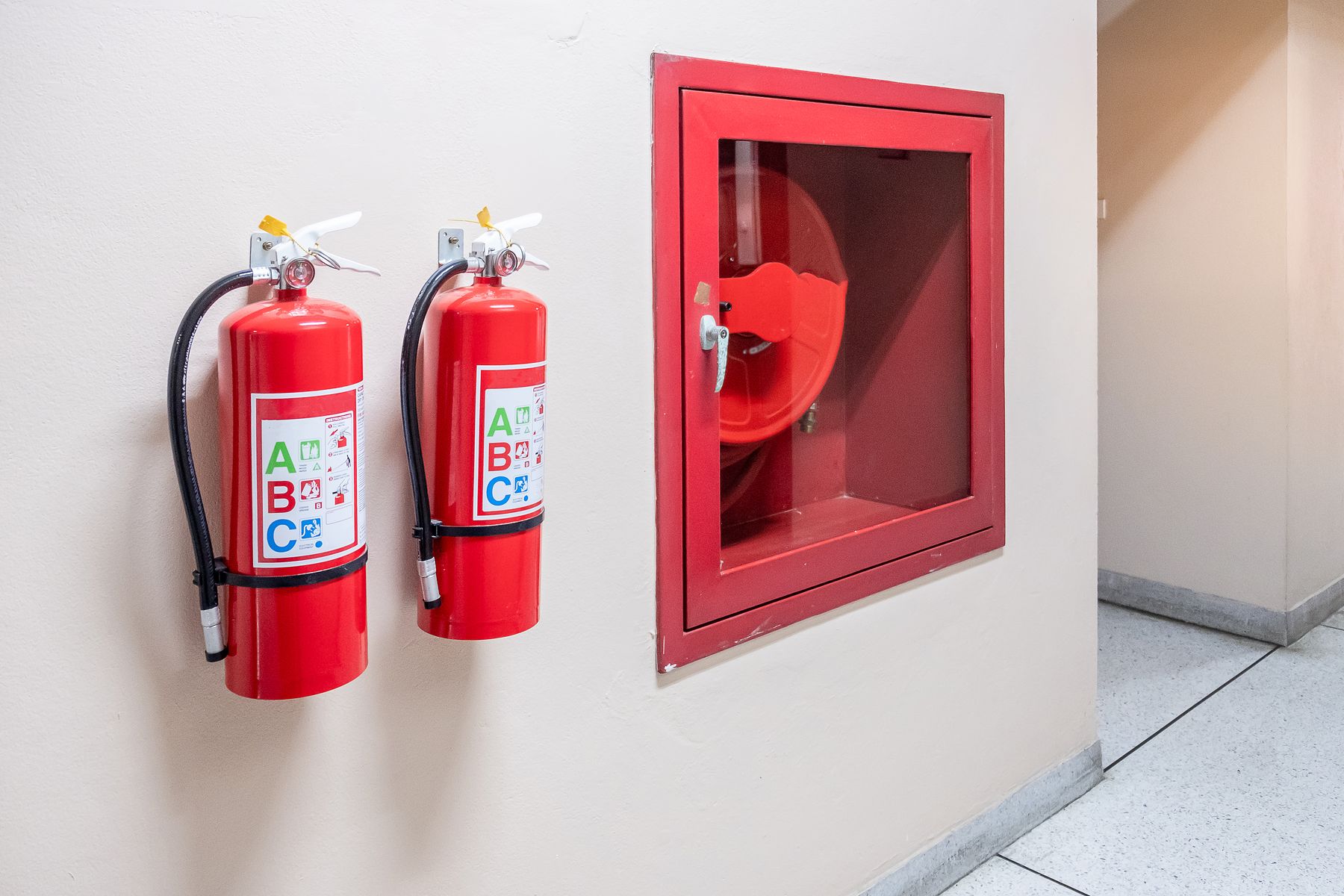
An ABC-rated extinguisher works on Class A, B, and C fires. Using the wrong agent — water on an oil fire, foam on an electrical panel, ABC powder on burning lithium — can spread the fire, cause electrocution or violent re-ignition. The cost of a wrong extinguisher choice is rarely the extinguisher.
1. ABC Dry Powder (Mono-ammonium phosphate)
Mono-ammonium phosphate (NH₄H₂PO₄), pressurised with dry nitrogen, is the most common general-purpose agent in Indian buildings. It works through three mechanisms simultaneously: chemical chain-reaction inhibition (the dominant effect), thermal cooling, and a melted phosphate residue that smothers Class A glowing embers.
Standard: IS 15683:2018 (portable) and IS 16018:2012 (for the dry powder itself, 90% min MAP content).
Capacity range: 1, 2, 4, 6 and 9 kg portable; trolley-mounted units up to 75 kg.
Fire ratings (typical, IS-tested): 4 kg unit = 2A 21B C; 6 kg = 3A 34B C; 9 kg = 4A 89B C.
Refill cycle: every 3 years; hydrostatic test every 5 years.
Best for: offices, retail, godowns, common corridors, vehicle bays.
Avoid: server rooms (powder ingress destroys electronics), commercial kitchens (powder cannot saponify hot oils).
2. Carbon Dioxide (CO₂)
CO₂ is stored as a liquid under its own vapour pressure (~58 bar at 20 °C) and discharges as a white cloud at –79 °C. It works through oxygen displacement (smothering) and minor cooling. The discharge horn must be plastic, not metal, because the rapid pressure drop can drive the metal to liquid-nitrogen temperatures and cause cold-burn injury.
Standard: IS 15683 portable / IS 2878:2004 for fixed CO₂ systems.
Capacity range: 2, 3, 4.5, 6.5, 9, 22.5 and 45 kg (trolley).
Fire ratings: 4.5 kg = 21B; 9 kg = 55B; both rated for energised electrical equipment up to 35 kV.
Refill cycle: every 5 years; weight loss above 10% triggers refill regardless of date.
Best for: electrical panels (LT/HT), server rooms, BMS rooms, lab equipment, transformer rooms.
Caution: CO₂ is an asphyxiant. After discharge in a confined space, ventilate before re-entry. Design concentration in fixed-system rooms is 34–75% by volume — never re-occupy without monitoring.
3. Clean Agent (HFC-227ea / Novec 1230)
Clean agents are halocarbon gases (heptafluoropropane HFC-227ea, marketed as FM-200, or fluoroketone FK-5-1-12, marketed as Novec 1230) that interrupt combustion's free-radical chain at the molecular level. They leave zero residue, are non-conductive, and at design concentration (≈7% for FM-200) are safe for human exposure long enough for evacuation.
Standard: ISO 14520 / NFPA 2001 (no Indian-specific code yet — design follows NFPA).
Capacity range: 1, 2, 4, 6 kg portable; cylinders 40–180 kg for fixed total-flooding systems.
Refill cycle: every 5 years; pressure drop below the green-zone triggers immediate service.
Best for: data centres, telecom rooms, archives, museums, MRI rooms, gas turbines.
Cost note: Clean-agent fills cost 5–10× the equivalent ABC because the agent itself is expensive and globally regulated. A 6 kg clean-agent unit will quote ₹15,000–35,000 against ₹2,500–4,500 for a 6 kg ABC.
4. Mechanical Foam (AFFF — Aqueous Film-Forming Foam)
AFFF is a synthetic foam concentrate (typically 3% or 6% by volume) mixed with water and discharged through an aspirating nozzle. It blankets a flammable-liquid surface, suppresses vapour release and floats on hydrocarbons. It works on both Class A and Class B fires but has limited effectiveness on alcohols and polar solvents — those need AR-AFFF (alcohol-resistant) variants.
Standard: IS 15683 (portable); IS 4308:2003 (foam concentrate); IS 12835 (high-expansion foam).
Capacity range: 6 L and 9 L portable; trolley-mounted up to 50 L.
Fire rating: 9 L = 21A 144B.
Refill cycle: every 12 months — foam concentrate degrades faster than dry agents.
Best for: petrol pumps, diesel storage, paint stores, chemical warehouses, aviation hangars.
Environmental note: traditional AFFF contains PFAS ("forever chemicals"). PFAS-free fluorine-free foams (F3) are now available and increasingly specified for new installations.
5. Water-Mist
Water-mist extinguishers atomise water at 5–10 bar through a specialised nozzle into droplets typically under 200 µm. The fine droplet size achieves three effects unavailable to a coarse water stream: rapid evaporation that absorbs heat (one litre evaporating absorbs 2,260 kJ), oxygen displacement at the flame zone via the steam volume expansion (1:1,700), and electrical safety because the discontinuous water column does not carry current at typical mains voltage.
Standard: IS 15683 (portable); BS EN 1568-3 (mist systems).
Capacity range: 4, 6, 9 L portable; 45 L trolley.
Best for: hospitals, schools, hotels, museums, retail — anywhere powder residue would be unacceptable.
Limitation: low penetration into deep-seated Class B pool fires; not the right tool for petrol pumps.
6. Wet Chemical (Class K)
Wet chemical agent is potassium acetate or potassium citrate dissolved in water. When discharged onto burning cooking oil, the alkaline salt reacts with the fatty acids in the oil (saponification), producing a stable soap-like foam blanket that simultaneously cools the oil below its auto-ignition temperature and seals out oxygen. No other agent class achieves both effects on hot oil.
Standard: IS 15683 portable; UL 300 / EN 3-7 for fire rating.
Capacity range: 4, 6 and 9 L.
Fire rating: 6 L unit = 13A 75F.
Best for: commercial kitchens, hotel galleys, food-court ranges, fast-food kitchens.
Mandatory pairing: Class K extinguishers are required wherever a deep-fat fryer or open-flame range is in continuous use — they are NOT a substitute for, but a supplement to, an automatic kitchen-hood suppression system.
Quick reference table
| Type | Standard | Class | Best location | Refill |
|---|---|---|---|---|
| ABC Powder | IS 15683 | A · B · C · electrical | Offices, shops, corridors | 3 yrs |
| CO₂ | IS 15683 | B · electrical (≤35 kV) | Server / panel rooms | 5 yrs |
| Clean Agent | NFPA 2001 | A · B · C · electrical | Data centres, archives | 5 yrs |
| Foam (AFFF) | IS 4308 | A · B | Petrol pumps, oil storage | 1 yr |
| Water-Mist | IS 15683 | A · F · electrical (rated) | Hospitals, hotels, schools | 1 yr |
| Wet Chemical | IS 15683 | K (cooking oils) | Commercial kitchens | 1 yr |
How many extinguishers does your building need?
NBC 2016 Part 4 (Annex E) and IS 2190:2010 give explicit rules. The short version:
- One unit per 200 m² of occupied floor area, minimum.
- Travel distance to the nearest extinguisher: 15 m for Class A hazards, 9 m for Class B.
- Electrical: at least one CO₂ or clean-agent unit within 5 m of every distribution board, server rack and major motor control centre.
- Mounting height: 1.0 to 1.5 m from finished floor to carrying handle (so the average operator can lift it cleanly).
- Signage: photoluminescent pictogram directly above each unit, visible from at least 7.5 m.
- High-rise + assembly buildings: double the count and pair every Class-A unit with a Class-B unit.
The NBC numbers are minimums. Insurance underwriters and the local Chief Fire Officer often impose stricter site-specific requirements, especially for petrochemical and hospital buildings. For a precise count, ask a fire-safety engineer to do a site walk-through. Technofire offers this audit free of charge across NCR, Jharkhand and Chhattisgarh — request a slot here.
Refilling, testing and the law
Indian standards mandate three documented activities through the life of every extinguisher:
- Monthly visual check — pressure gauge in the green band, tamper seal intact, hose unobstructed, signage and access clear, mounting bracket secure. Logged in a register.
- Annual full inspection — net-weight verification (loss above 10% triggers refill), valve and gauge function test, hose pressure test, cosmetic and structural review of the cylinder body.
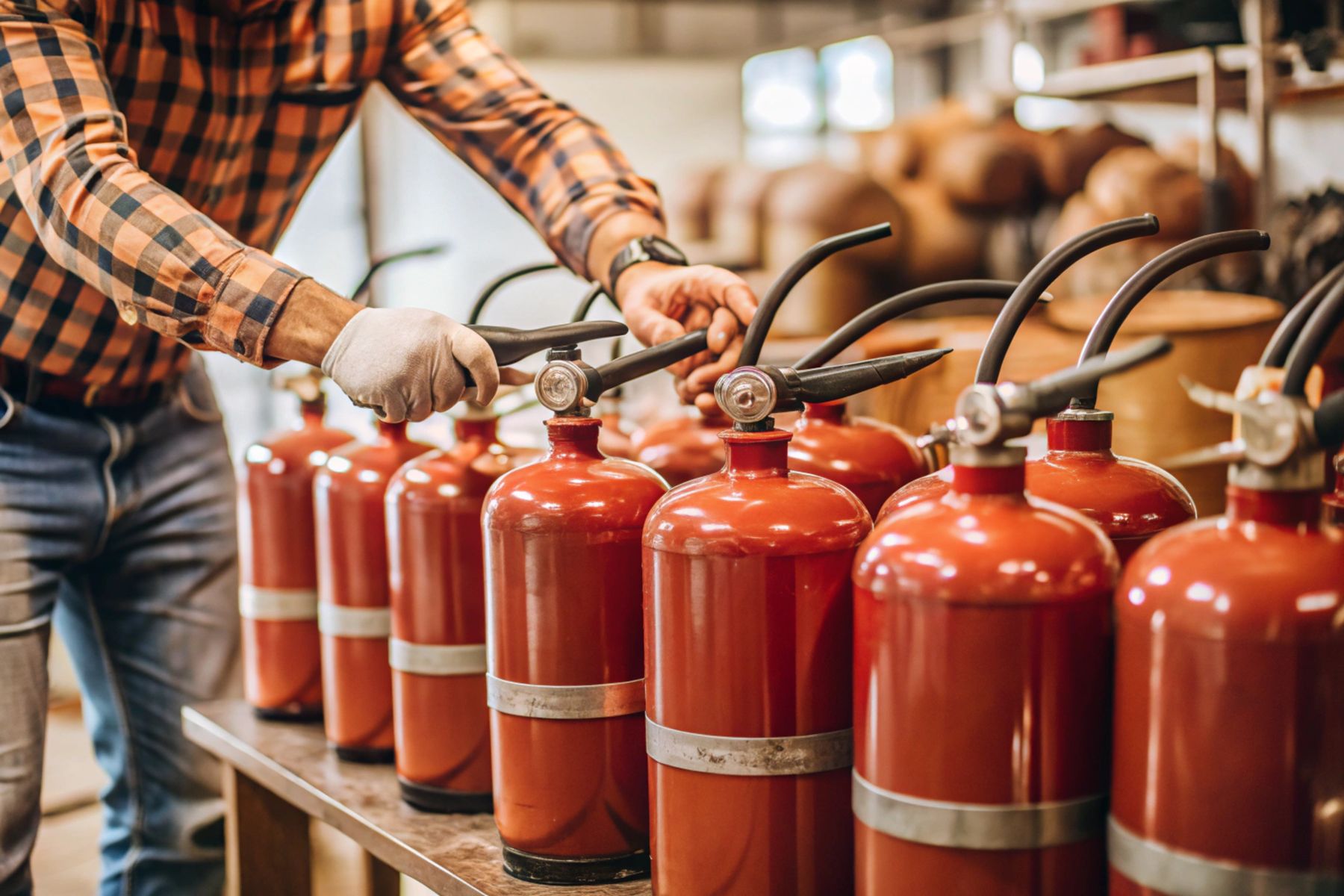
- Refilling — at the interval set by IS 2190 (3 years for ABC, 5 years for CO₂ & clean agent, 1 year for foam & wet chemical) or immediately after any discharge.
- Hydrostatic test — every 5 years on the cylinder body itself, regardless of refill cycle. The cylinder is filled with water and pressurised to 1.5× working pressure; any deformation or leak retires the cylinder permanently.
All of this is exactly what a properly-run Annual Maintenance Contract covers — and it's the single largest line item between "compliant" and "non-compliant" at a fire-NOC inspection.
The right extinguisher in the wrong place is the wrong extinguisher. Match the unit to the hazard, not the budget line.
Decision framework: choosing the right mix
For a typical commercial site, work through these questions in order:
- What's the dominant hazard class? Most offices are Class A + electrical → ABC + CO₂ pairing.
- Are there sensitive electronics? Server rooms / data centres → CO₂ portable + clean-agent flooding.
- Is there cooking? Any deep-fat or open-flame cooking → wet chemical + automatic hood system. Mandatory.
- Are there flammable liquids? Petrol, paint, oil bulk > 50 L → foam (AFFF or F3) + ABC.
- Cleanliness requirement? Hospitals, museums, hotel guest areas → water-mist instead of ABC for common corridors.
- Voltage exposure? Sub-stations, HT panels (>35 kV) → CO₂ alone is insufficient; specify clean agent or fixed CO₂ flooding.
The right answer is rarely "one type everywhere". A typical mid-sized office floor needs at least three: ABC for general areas, CO₂ for the server room and electrical panel, and wet chemical if there's a kitchenette with hot oil cooking.
Need help picking the right mix for your site?
Send us your floor plan or a quick site description and we'll mark up where each extinguisher should go, what class it should be rated for, and what it'll cost across capital expenditure and three-year maintenance. Get a free fire-safety quote or browse our full product catalogue with capacity-by-capacity specifications.